Top 9 ManyChat Alternatives for 2026, Free Options Included

For most of you the question isn't which ManyChat alternative or competitor is best. It's which one is best for what you're doing.
If you're automating Instagram DMs, the right pick looks nothing like the right pick for a WhatsApp-first support team, and both are completely different from what a developer building a custom AI agent needs.
In this guide we will skip the one-size-fits-all ranking and sort nine tools by use case instead, so you can find the right ManyChat alternative which can be actually helpful for your business.
Heroic Inbox
A simple and affordable helpdesk for small businesses.
Unlimited users and powerful features.
In This Guide
Why ManyChat (A Quick, Fair Review)

ManyChat is the go-to tool for automating conversations on Instagram and Facebook Messenger, and it has earned its place. In about two minutes, you can connect an account, drag a few blocks around, and create a working comment-to-DM funnel. All that without touching the code.
What ManyChat does well:
- Instagram depth: The biggest template library and the most reliable comment and story-mention triggers on the market.
- Fast setup: An account connection takes about two minutes, and you can ship a working flow without touching code.
- Multi-channel reach: Instagram, Facebook Messenger, WhatsApp, TikTok (beta), SMS, and email under one dashboard.
- Enterprise-grade security: SOC 2 Type II and ISO/IEC 27001 certifications, which is more important than most creators realize once they scale.
ManyChat pricing in 2026 runs from a free plan up through four paid tiers:
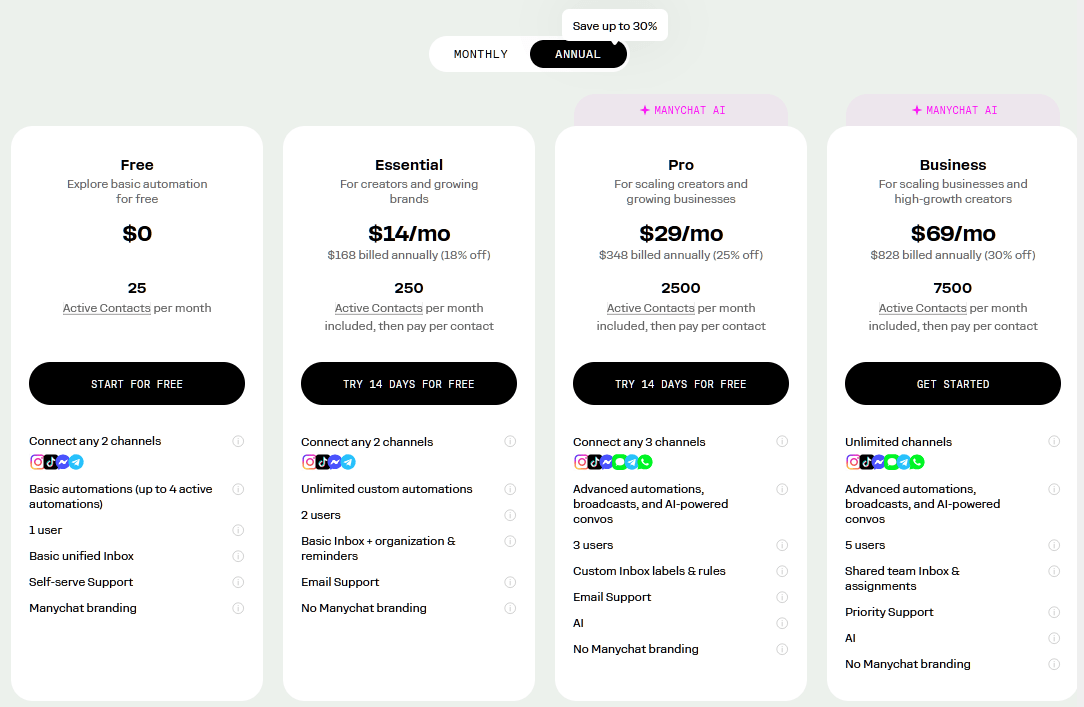
- The free plan now covers just 25 contacts with basic features
- Essential starts at $14/month for 250 contacts
- Pro runs $29/month for 2,500 contacts
- Business and Advanced climb to $69 and $139/month
- The AI Hub is a separate add-on near $29/month
If your whole world is Instagram DMs and you're under a thousand contacts, ManyChat is still a rational choice.
The problems start when you grow.
Why Look for ManyChat Alternatives?
Money. That's the single biggest reason people search for ManyChat competitors in 2026, and specifically the March 2, 2026 pricing overhaul.
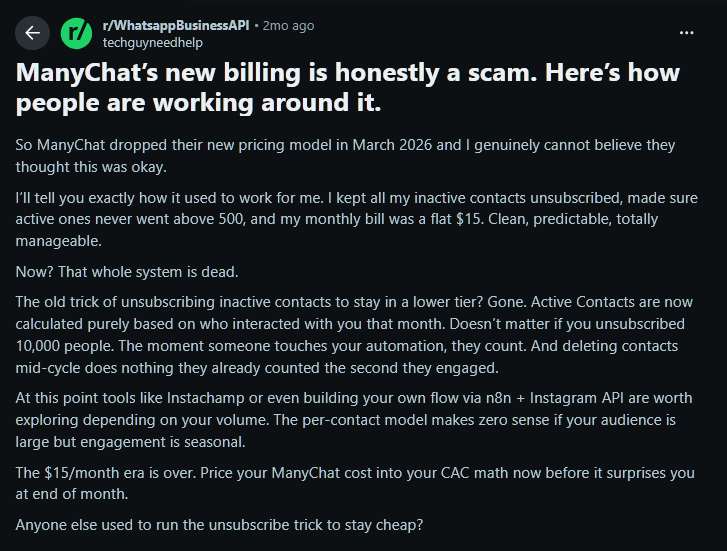
ManyChat replaced its old free-and-pro structure with a finely tiered model. In the process, it slashed the generous free plan of 1,000 contacts down to just 25. That's a reduction of about 97.5%.
That single change sent a wave of users searching for free ManyChat alternatives overnight.
For anyone who built an audience on the old free tier, the change felt like a rug pull, and the community reaction on Reddit was loud.
There are a handful of other recurring reasons people switch to ManyChat competitors:
- Lower tiers have contact and channel caps that force upgrades sooner than expected. WhatsApp, SMS, and AI features carry separate fees on top of your plan.
- Support that is email-only and slow, which stings for a company whose whole pitch is faster conversations.
- Account bans and billing disputes, with a small but vocal cluster of reviews describing accounts terminated without warning or plans auto-upgraded without consent.
- AI that lags the competition, since ManyChat's built-in AI is still more basic than the GPT-class agents now baked into rivals like Chatfuel and Intercom.
Community sentiment on ManyChat leans positive for simple comment-to-DM funnels. But it turns sharply critical around cost escalation, thin support, and billing surprises once you run complex flows at scale.
The Best ManyChat Alternatives for 2026

We rigorously test and research every product that we recommend through HeroThemes. Our review process. We may also earn a commission if you make a purchase through our links.
Now let's look at the best ManyChat alternatives and competitors. These are the tools that are worth switching to. They are sorted so that you can jump to the one that fits your needs.
1. HelpJet
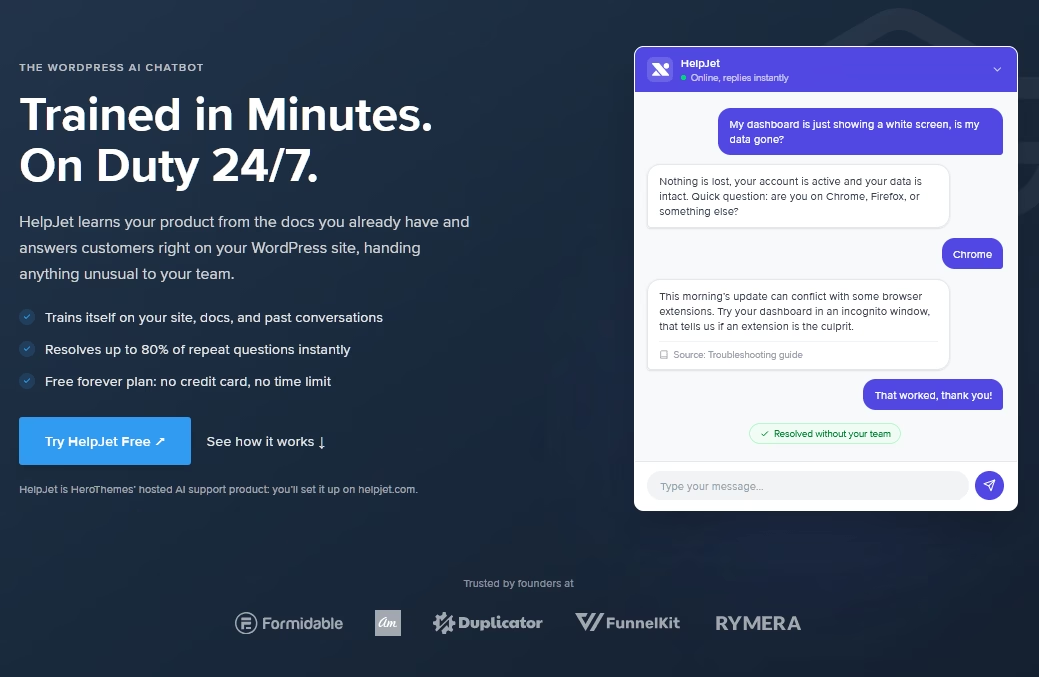
Most tools on this list are trying to help you sell more. HelpJet on other hand is trying to make sure your customers don't have to wait for an answer in the first place.
It's an AI support chatbot from HeroThemes, the team that has spent about 15 years building customer-support software.
HelpJet works with simple fundamentals: point it at the content you already have (help docs, website pages, PDFs, past support chats) and it turns that into an answer engine that resolves the boring, repetitive questions eating up your team's time.
If the real reason you're shopping around is that your “chat” tool has quietly become your support channel, and you're drowning in the same five questions, HelpJet does that one job better than any general-purpose flow builder.
Pros
- Genuine free forever plan (1 bot, 100 interactions per month) — unlike ManyChat's 25-contact limit, this one is actually usable. Try every feature before you scale.
- Five-minute install through the WordPress plugin or a single line of code on any other site, including Shopify, Wix, and Webflow.
- Automatic weekly re-crawl so answers stay current without you thinking about it.
- Intent-based answering that reads what a customer means, handles typos, and skips the “I didn't understand that” loop.
- Clean handoff to a form or email when the bot can't resolve something.
- No per-agent pricing: There's no cap on team members, which is a real cost advantage over seat-based rivals.
Cons
- It's new. HelpJet launched in 2026.
- It's not a full help desk. If you need a ticket queue, pair it with a shared inbox tool like Heroic Inbox.
- It's support-focused, not marketing. No Instagram comment triggers, broadcasts, or sales sequences, by design.
Pricing
HelpJet's free-forever plan costs $0 and includes one bot with 100 conversations per month, no credit card required.
The Pro plan runs $29 per month (about $23 per month billed annually) and lifts you to three bots and 1,000 conversations per month.
2. Chatfuel
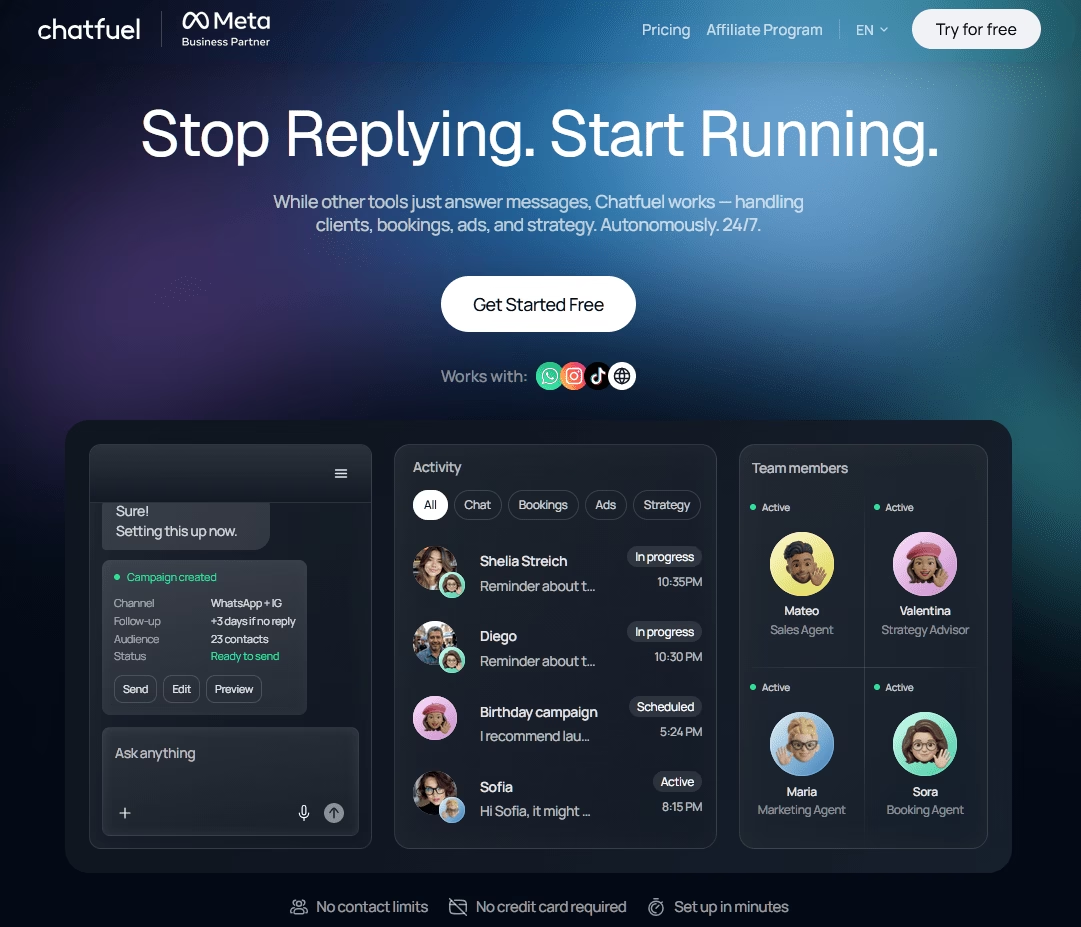
Chatfuel has been automating Facebook Messenger conversations since the earliest days of the category.
Chatfuel is the closest ManyChat competitor in the market: a no-code visual builder for bots across Instagram, Messenger, WhatsApp, TikTok, and a website widget.
So if you like ManyChat's approach but want stronger built-in AI, this is the most natural place to land.
Pros:
- Familiar no-code builder with a large template library, easy to pick up if you're coming from ManyChat.
- Built-in GPT-class AI agents for FAQs, lead qualification, and product recommendations.
- Multi-channel Meta coverage across Instagram, WhatsApp, Messenger, and TikTok, plus a website widget most rivals lack.
- Commerce automations including cart recovery and order taking, with Shopify, Stripe, and Zapier integrations.
- Shared inbox and live chat with multi-agent support for handoffs.
Cons:
- No lasting free plan, only a short trial after the 2026 pricing change.
- Meta-first channel gaps. No native Telegram, SMS, or email broadcast.
- Flows don't transfer between channels, so you rebuild per channel.
- AI usage caps with fair-use allowances that are hard to verify before you pay.
Pricing
Chatfuel's AI-tiered plans start around $39/month for roughly 150 contacts.
3. Respond.io
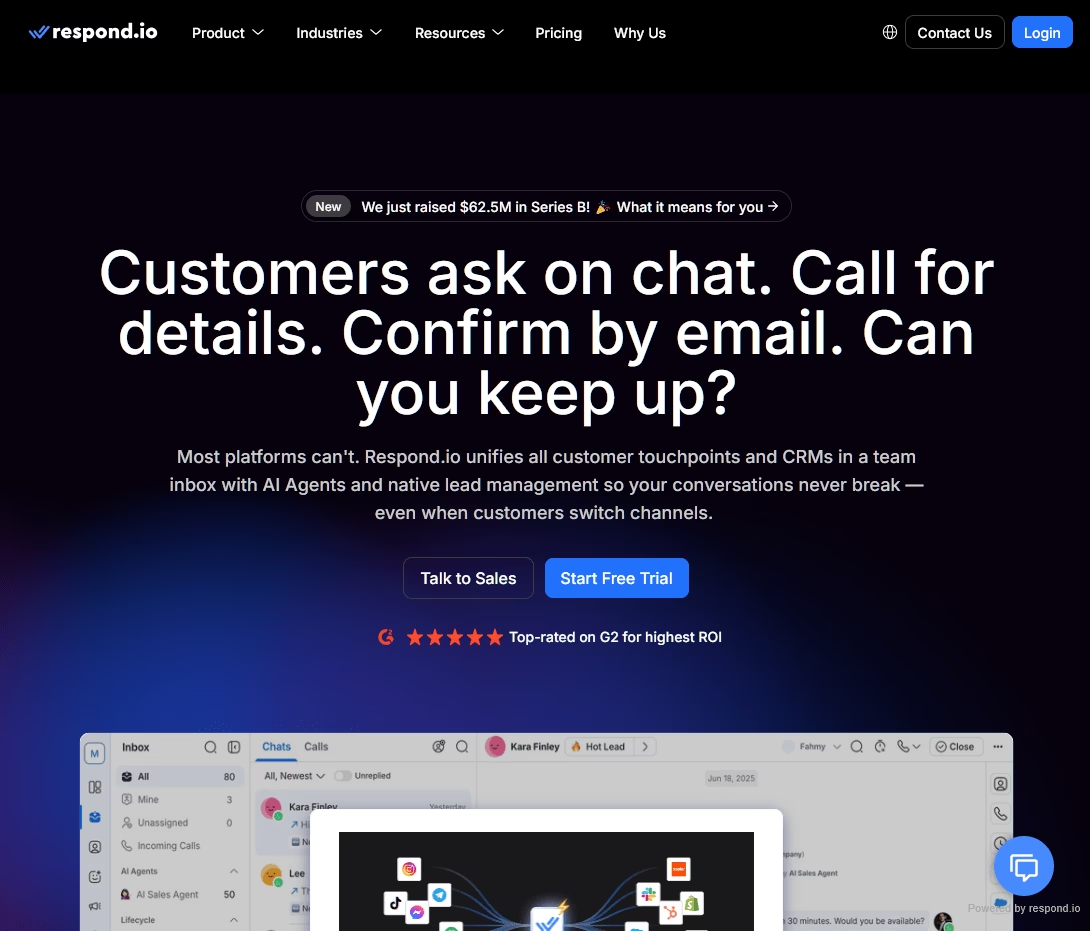
Are you a solo creator, or a team of ten answering messages across six apps at once?
If it's the second one, Respond.io is built for exactly your kind of chaos.
It's an omnichannel messaging platform that pulls WhatsApp, Instagram, Messenger, Telegram, SMS, and email into a single inbox.
The standout is the automation builder: chatbot responses, auto-assignment, routing rules, and triggered actions, all with a depth ManyChat can't match.
Pros:
- Unified omnichannel inbox
- Powerful workflow automation with routing, auto-assignment, and AI agents on higher tiers.
- WhatsApp API partner status with zero platform markup on Meta fees, plus WhatsApp calling support.
- Beginner-friendly onboarding with product tours that soften an otherwise steep learning curve.
- CRM integrations and broadcasts for both support and sales motions.
Cons:
- No free plan.
- Contact-based billing that can balloon from the sticker price into several hundred dollars.
- Overkill for small teams whose needs are met by cheaper WhatsApp-specific tools.
Pricing
Respond.io's Starter plan starts at $79 per month and includes five users, but lacks automation and AI features.
All plans bill Meta's WhatsApp fees separately. A 7-day free trial is available instead of a free tier.
4. Landbot
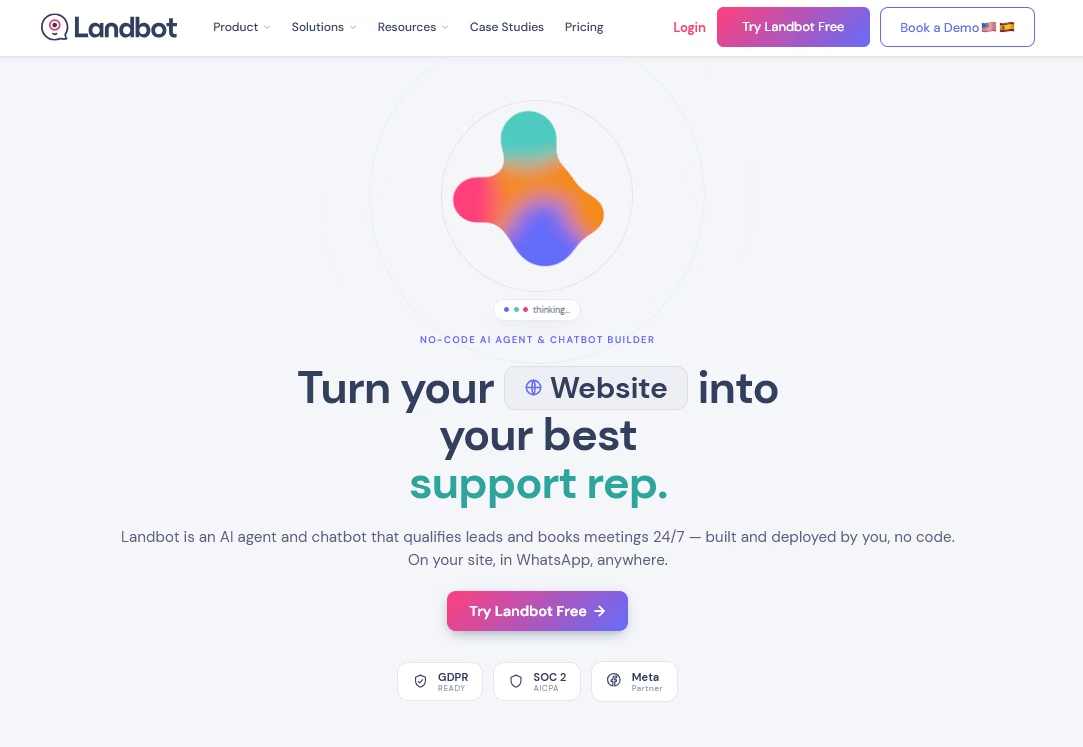
Landbot approaches chat from a designer's mindset, and that's its whole charm. Its drag-and-drop flow builder is one of the friendliest in the business, and for structured, form-like conversations (lead capture, surveys, appointment routing) it's a pleasure to use.
The company has repositioned around AI over the last couple of years, layering GPT and Gemini-powered blocks on top of its scripted foundation.
Landbot works across websites, WhatsApp, and Facebook Messenger, making it a strong ManyChat alternative for marketers who want on-brand chatbots that double as lead-gen tools.
Fair expectations, though: Landbot is fundamentally a flow builder. AI answering is a feature inside your flow, not the engine of the whole conversation.
Pros:
- Best-in-class visual flow builder with buttons, carousels, date pickers, and rich conditional logic.
- Conversational landing pages that many teams use as full lead-capture experiences, not just widgets.
- Hybrid approach that blends structured flows with native AI steps.
- Multichannel deployment across web, WhatsApp, and Facebook Messenger.
- AI Copilot that builds flows from natural-language descriptions
- Solid integrations
- A useful free Sandbox tier for testing before you pay.
Cons:
- The dedicated WhatsApp tier raises costs sharply.
- AI chats are billed separately from regular chats, on top of your plan.
- Rule-based roots make it less naturally conversational than pure-AI tools for unscripted questions.
Pricing
Landbot offers a free Sandbox plan covering 100 chats per month. Paid tiers are commonly cited as roughly €40 per month (Starter, about $46), €100 per month (Pro, about $105), a WhatsApp plan from about €200 per month (roughly $233), and Business from about €400 per month.
Annual billing knocks off about 20%, and all plans meter chats rather than relying on seats alone.
5. Botpress
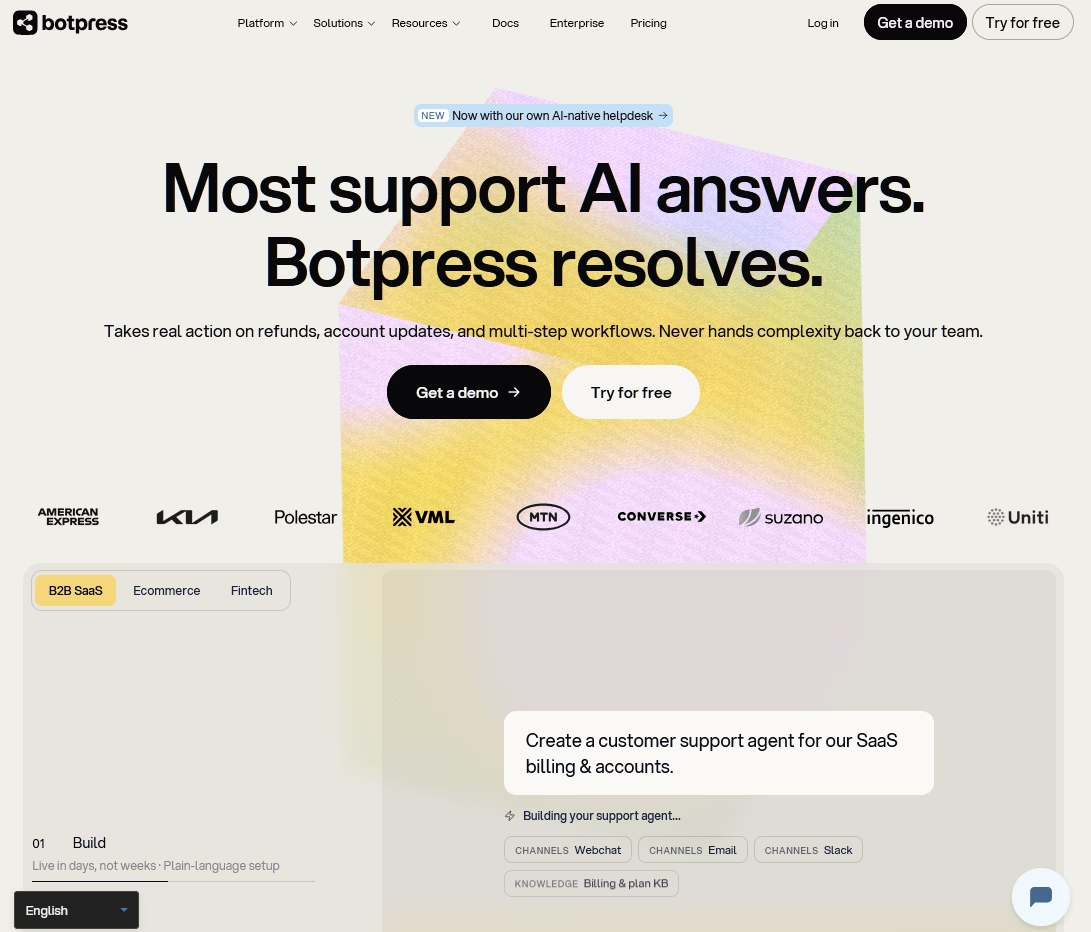
Developers, this one is for you.
Botpress is an open-source, LLM-native platform for building AI agents. It is the polar opposite of ManyChat's point-and-click simplicity.
It began as one of the better-known open-source chatbot frameworks and has since become a hosted platform where a large language model is the reasoning engine at the center, not a bolted-on feature.
It's far more powerful and far more complex than anything else on this list, and it expects you to bring engineering time.
Pros:
- LLM-native autonomous engine that combines AI reasoning with structured workflows in one runtime.
- Open-source self-hosting (the V12 edition) for teams that need full control over data and infrastructure.
- Multi-LLM support (OpenAI, Claude, Gemini) with routing and your own API keys.
- Deep integration hub and API access for custom code actions and enterprise systems.
- Enterprise posture including SOC 2 and GDPR compliance. It serves solo builders through Fortune 500s.
Cons:
- Requires technical expertise to set up and maintain.
- Usage-based AI spend layered on top of the plan fee can surprise first-time buyers.
- Overkill for simple marketing bots.
Pricing
Botpress offers a free plan that allows for 100 conversations per month. Premium plans start at $189 per month and unlock advanced features, offering more conversations.
6. Brevo Conversations
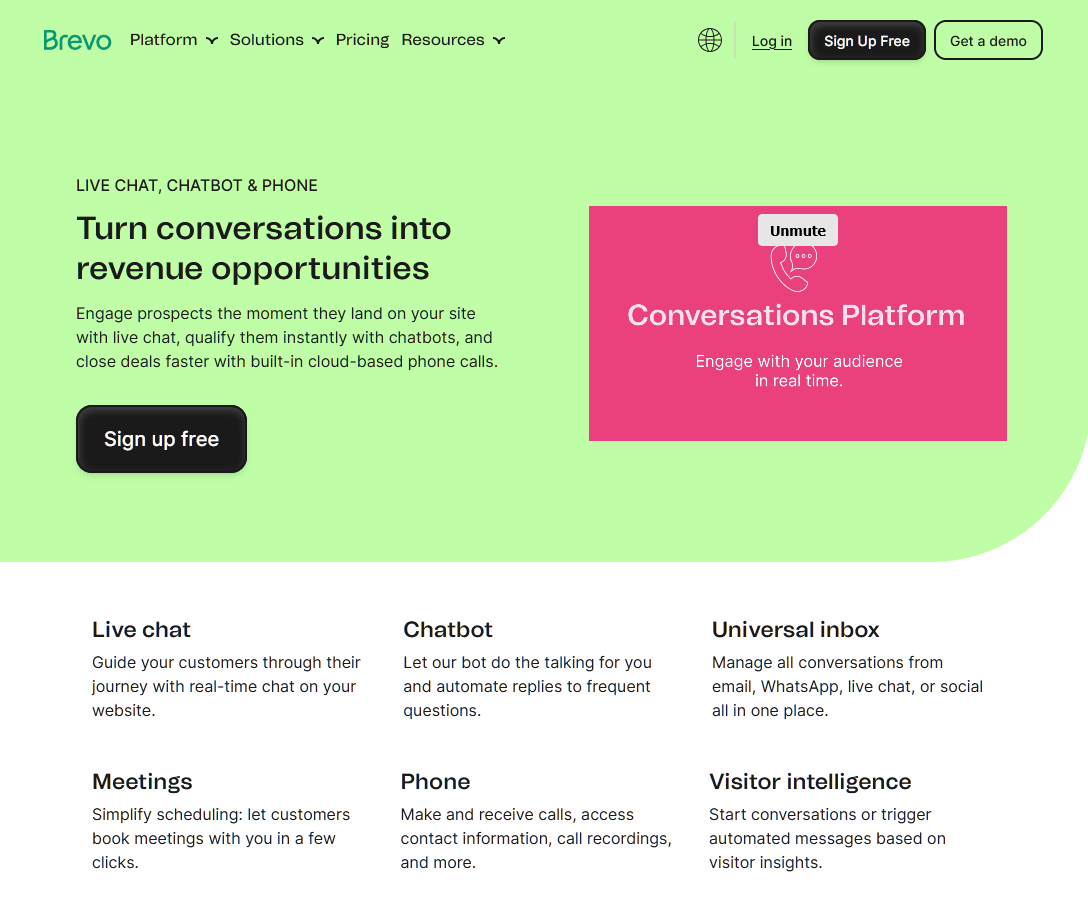
Brevo is proof that “chat tool” and “marketing platform” don't have to be separate line items on your budget.
Brevo is an all-in-one customer engagement suite. Its Conversations module adds live chat, chatbots, and social messaging to email marketing, SMS, and CRM.
Since all channels feed into a single contact record, a complaint received via chat can automatically pause a promotional email sequence. This kind of integrated behavior is impossible with fragmented stacks. Or with ManyChat, which has no shared contact record across channels.
The Conversations widget is more capable than we expected, with unlimited live chat even on the free plan, FAQ bots, and a social inbox for Facebook, Instagram, and WhatsApp.
Pros:
- Unified contact database feeding marketing, sales, chat, and transactional messaging so channels coordinate automatically.
- Conversations widget with unlimited live chat, FAQ bots, triggers, and visitor analytics.
- Social inbox consolidating Facebook, Instagram, and WhatsApp messages.
- Broad integrations with Shopify, WooCommerce, HubSpot, Zapier, and Make.
- Volume-based email pricing that charges by emails sent rather than contacts stored. That's unusually kind to large lists.
Cons:
- Conversations is a separate paid module, billed per user on top of your marketing plan.
- Advanced reporting sits behind higher tiers.
Pricing
Brevo offers a free plan with limited features (300 emails per day). Premium plans start at $9 per month and unlock additional features and daily email limits.
7. Freshchat
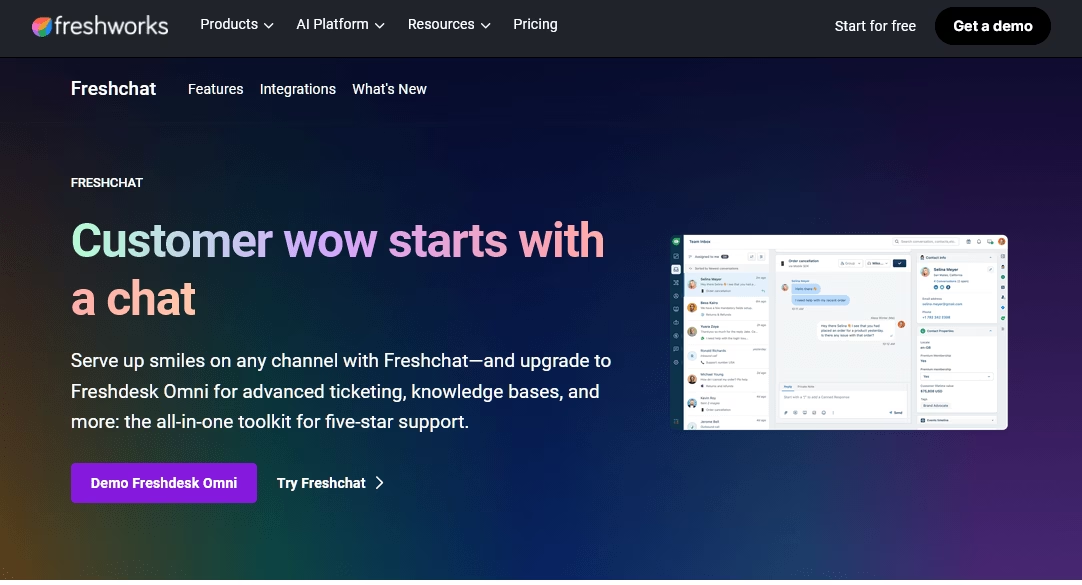
Freshchat is for support teams that want a real customer-messaging platform without an enterprise invoice. Part of the Freshworks suite, it combines live chat, bots, and multi-channel messaging.
Budget-conscious buyers will appreciate the free plan that supports up to 10 agents, a rare feature. This makes Freshchat one of the strongest free alternatives to ManyChat for teams whose bottleneck is support rather than social marketing.
Pros:
- Free plan for up to 10 agents with website live chat and a team inbox.
- Freddy AI agents trained on your own docs, URLs, and FAQs.
- True multi-channel support across web, WhatsApp, Instagram, Messenger, and SMS.
- Deep Freshworks integration for unified context across tickets and CRM.
- Transparent per-agent pricing plus usage-based AI add-ons and 400-plus marketplace apps.
Cons:
- No chatbot on the free plan, so it's human-led live chat until you upgrade.
- Metered AI sessions billed in blocks that can inflate the bill.
Pricing
Freshchat has a free-forever plan for up to 10 agents, then:
- Growth at $19/agent/month
- Pro at $49/agent/month
- Enterprise at $79/agent/month, all billed annually.
Freddy AI is a usage-based add-on.
8. Intercom (Fin AI)
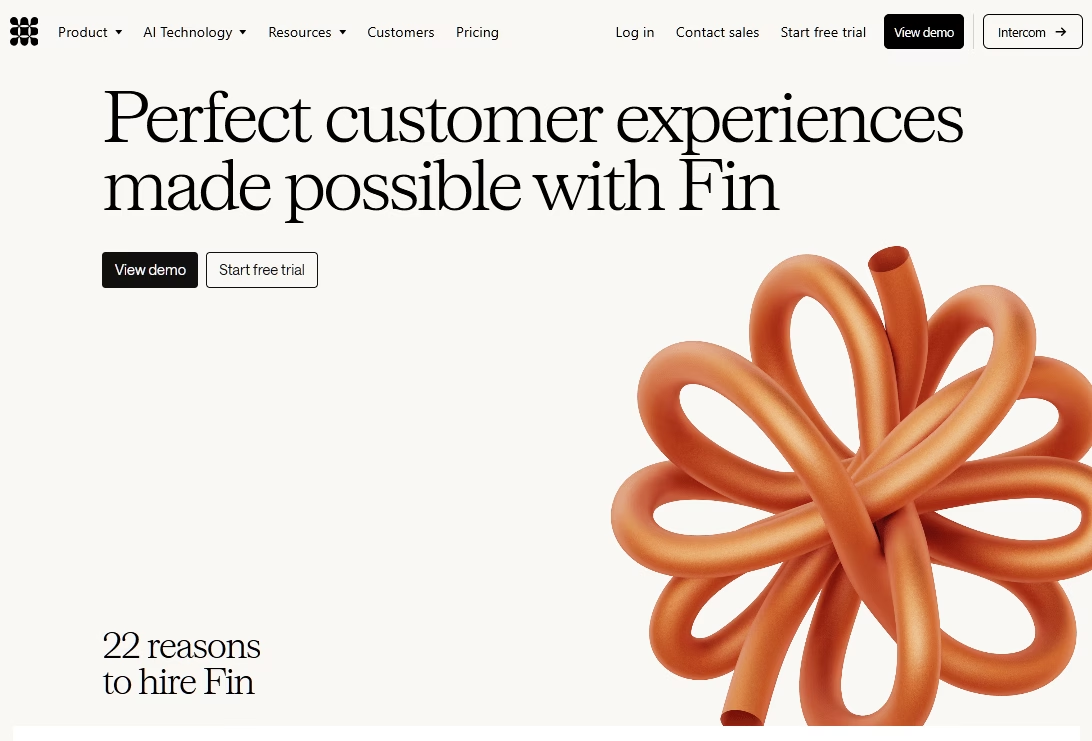
In 2026, Intercom has effectively bet the company on AI. It combines live chat, a help desk, and proactive messaging. However, the centerpiece is now Fin, its AI agent. In fact, the company rebranded around Fin.
Fin reads a customer's question, finds the answer in your content, and resolves it across web chat, email, SMS, and WhatsApp.
Pros:
- Fin AI agent with strong retrieval, resolving questions across chat, email, SMS, and WhatsApp.
- Full support suite: messenger widget, shared inbox, ticketing, help center, and reports on every plan.
- Proactive support via campaigns, banners, and tooltips.
- Outcome-based AI billing at $0.99 per resolution, with no charge when Fin hands off to a human.
- Standalone Fin option that can run on top of other helpdesks, including Salesforce, Zendesk, and HubSpot.
Cons:
- Seat plus usage plus channel fees stack well above the headline seat price.
- Overkill as a direct ManyChat competitor for social marketing, since this is a support platform first.
Pricing
Intercom uses three seat-based plans, with the Essential seat around $29/month. Fin is billed at $0.99 per outcome on top.
9. WATI
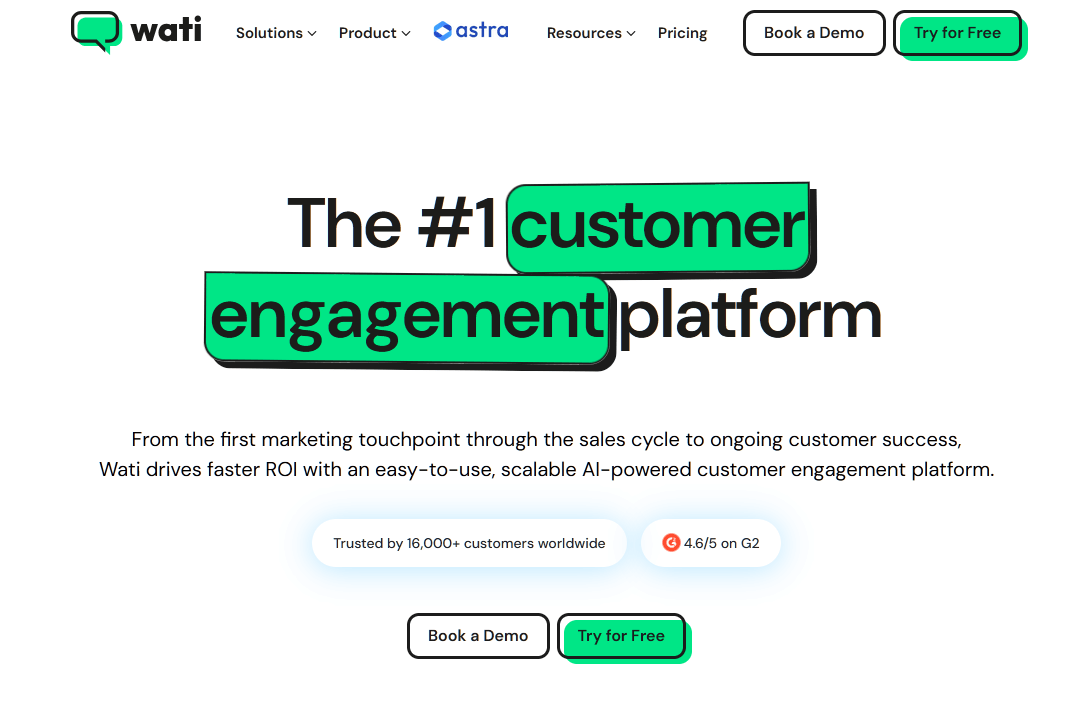
WhatsApp is the primary channel for entire economies, and WATI is one of the most recognized tools built specifically to tame it.
It's a WhatsApp Business API platform with a shared team inbox, broadcast campaigns, no-code chatbots, and template management, aimed at small-to-mid businesses that live and die by WhatsApp.
In 2025, WATI evolved from a basic team inbox into a comprehensive AI-powered platform. It added features such as conversation summaries, a reply-suggesting co-pilot, and an AI support agent for customers on higher tiers.
It also expanded beyond WhatsApp into Instagram and Messenger, including comment-to-DM automation, which puts it in closer competition with ManyChat's core job.
Pros:
- Purpose-built WhatsApp Business API
- Broadcast and template tools for campaigns, order confirmations, and cart recovery.
- No-code chatbot and workflow automation with analytics dashboards.
- Instagram and Messenger expansion, including comment-to-DM automation.
- Shopify and CRM integrations plus expansion into Instagram and Messenger.
Cons:
- Pricing escalates and gets opaque as you add agents, sessions, and message volume.
- Steep extra-seat costs.
Pricing
WATI, on annual billing, costs about $59/month for Growth, $119/month for Pro, and $279/month for Business, with a custom Enterprise tier.
There's no permanent free plan (only a 7-day trial). Additionally, Meta's fees plus WATI's markup are billed on top.
Summary: Picking Your ManyChat Alternative
Here's how we'd actually choose after all of this.
Match the tool to your bottleneck, not the longest feature list. The “best” ManyChat alternative depends entirely on what broke for you in the first place.
- If your bottleneck is repetitive support questions: Start with HelpJet's free plan as your AI deflection layer, and pair it with a shared inbox and knowledge base if you need ticketing. This is the combination we'd reach for before paying for anything heavier.
- Botpress if you have developers who want to own the stack.
- For WhatsApp, choose WATI.
- For designed lead-gen flows, Landbot's builder is the most enjoyable to use.
Don't replace ManyChat with a more expensive version of the same thing out of habit.
If you're leaving because of cost and contact-based billing, be honest with yourself about whether you need marketing, support, or commerce tools. Then, pick the specialist alternative that best fits your needs.
Further Reading
Top MkDocs Alternatives and Competitors to Try in 2026
Best Help Scout Alternatives in 2026, Including Free Options
10 Best FREE Help Authoring Tools
Best FREE Software Documentation Tools for Developers
Best AI Chatbots for Customer Service (2026 Picks)
15 Chatbot Features Buyers Should Know About (Complete List)





Leave A Comment?
You must be logged in to post a comment.