17 Ways to Say “Sorry for the Inconvenience” (Professional Alternatives With Examples)


Every support team has a few stock phrases that become muscle memory. “Sorry for the inconvenience” is probably at the top of the list. It’s polite, professional, and safe, but it also says almost nothing.
To a customer who has been double-charged, missed an important deadline, or spent half an hour waiting for a reply, that familiar line rarely feels like a genuine apology.
After hearing it hundreds of times, many people barely notice it anymore.
For us, a good customer service apology isn’t about finding more formal words. It’s about matching your response to the situation, showing real ownership, and explaining what happens next.
In this guide, you’ll find 17 better alternatives to “sorry for the inconvenience,” including polite and professional apology phrases, when to use each one, and examples you can adapt for apology emails, live chat, support tickets, and more.
HelpJet – FREE AI Chatbot
Reduce customer frustration: Give customers quick, helpful answers around the clock, so they spend less time waiting for support.
In This Guide
Why Sorry for the Inconvenience Falls Flat
“Sorry for the inconvenience” has been used so many times, in so many auto-replies, that customers’ eyes slide right past it.
It reads as filler. When someone is frustrated, the last thing they want is filler.
Is it grammatically correct to say “sorry for the inconvenience”?
Sure, and variations like “apologies for any inconvenience caused” are just as correct. Nobody’s going to mark you wrong on a test, but correct and professional isn’t the same as being sincere.
Let’s walk through what the phrase actually does to your customer.
The word inconvenience takes their real problem (a missed deadline, a botched order, an outage that cost them money) and shrinks it down to the level of a long traffic light. That mismatch is what stings.
It’s like telling someone their flat tire is just a minor scheduling hiccup.
Here are a few specific reasons this generic apology (Sorry for the Inconvenience) backfires, and why so many customer service teams look for better phrases to replace it:
- It never names the problem. The customer wrote three paragraphs explaining what went wrong, and you answered with a phrase that could apply to literally anything.
- It hides behind passive, brand-flavored language. “We apologize for the inconvenience” keeps the company at a distance. Since no one takes ownership of the mistake, the apology feels like it came from a vending machine.
- It usually comes with a “but.” “Sorry for the inconvenience, but our policy is…” The “but” erases the apology that came before it.
- It skips the part they care about. Customers don’t want sympathy; they want their problem solved. This phrase doesn’t provide a cause or a next step.
Does any of this mean you shouldn’t use this phrase?
Not exactly. For tiny issues, like a five-minute checkout glitch, a quick “sorry for the inconvenience” or “sorry for the trouble” is perfectly fine. Reaching for fancier language here would be overkill.
The problem is using it as a one-size-fits-all bandage on wounds of every size. The bigger the issue, the more hollow it sounds.
When to Apologize to Customers: Situations That Call for More Than a Generic Apology
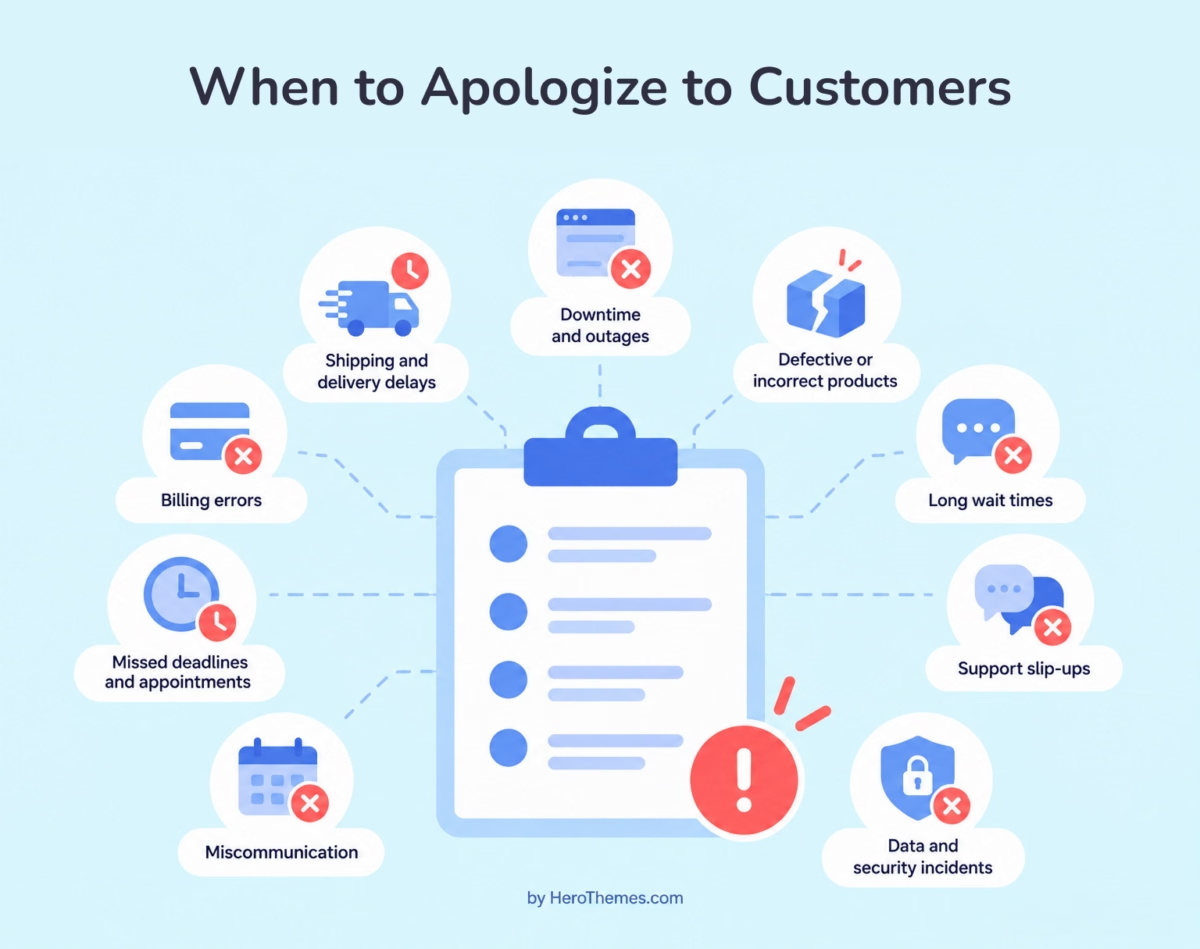
It helps to know which situation you’re in before we get to the alternatives because the right apology phrase depends on it.
Things break in every business, and you’ll recognize most of these situations from your own experience.
Here are the situations that usually call for an apology:
- Shipping and delivery delays: an order arrives late or never shows up.
- Billing errors: a customer gets double-charged, charged the wrong amount, or sent a confusing invoice.
- Downtime and outages: your app, site, or service goes dark in the middle of someone’s workday.
- Defective or incorrect products: the item shows up broken, missing parts, or just not what they ordered.
- Long wait times: hold queues, slow chat replies, or an email that sat unanswered for days.
- Missed deadlines and appointments: you promised a date or a service window and didn’t make it.
- Support slip-ups: a rep was short with someone, gave wrong information, or dropped the ball on a ticket.
- Miscommunication: unclear instructions, a broken promise, or details that got lost between two teams.
- Data and security incidents: a breach, an accidental exposure, or a login problem that rattles trust.
Notice something about that list?
Most of these aren’t small, which is why a generic apology like “Sorry For The Inconvenience” often fails to calm an upset customer.
How to Write a Professional Apology to Customers
Before you reach for any phrase, get the structure right.
A good apology follows a simple pattern that customers can feel even when they can’t name it.
The pattern is simple: lead with empathy, then move fast to the fix, because resolution is more important to people than the number of times you say “sorry.”
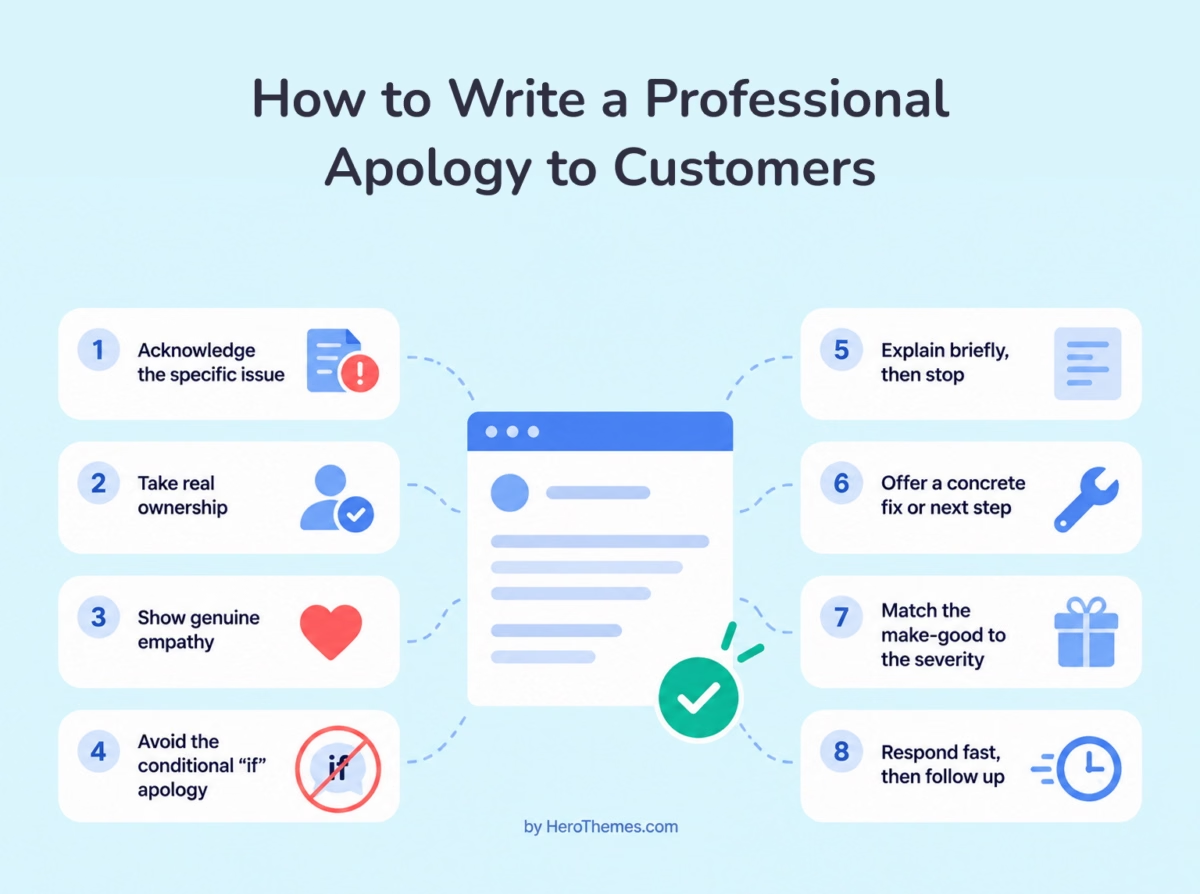
With that in mind, here’s how to apologize professionally:
- Acknowledge the specific issue. Say “I’m sorry our update caused repeated crashes yesterday,” not “sorry for the inconvenience.” Naming the problem proves you read it.
- Take real ownership. Use active, first-person language: “We made a mistake on our end.” Skip passive phrasing that hides behind the company.
- Show genuine empathy. Validate the frustration: “I understand how stressful this was, especially right before your launch.”
- Avoid the conditional “if” apology. Phrases like “Sorry if you were inconvenienced” quietly blame the customer for being upset. Drop the “if” entirely.
- Explain briefly, then stop. One honest sentence about the cause is enough. Never turn it into a list of excuses and never blame a teammate, vendor, or “circumstances beyond our control.”
- Offer a concrete fix or next step. For example, “I’ve refunded the difference, and it’ll land in three to five business days” always beats a vague promise like “we are looking into it.”
- Match the make-good to the severity. A small bug needs only a fix; an outage or billing error may warrant a credit, discount, or priority support.
- Respond fast, then follow up. Aim to reply within 24 hours, and sooner for high-severity issues like outages or breaches. Check back once it’s resolved.
The apology should be the opening of your reply, followed by a fix or more info.
Customers are far more likely to forgive a mistake than they are to forgive being ignored or brushed off afterward.
17 Better Ways to Say “Sorry for the Inconvenience”
What can you say instead of “sorry for the inconvenience”? Quite a lot, and the best choice always depends on what went wrong.
Here are 17 alternatives to “Sorry for the inconvenience”, grouped by the situation they fit best.
Heroic Inbox
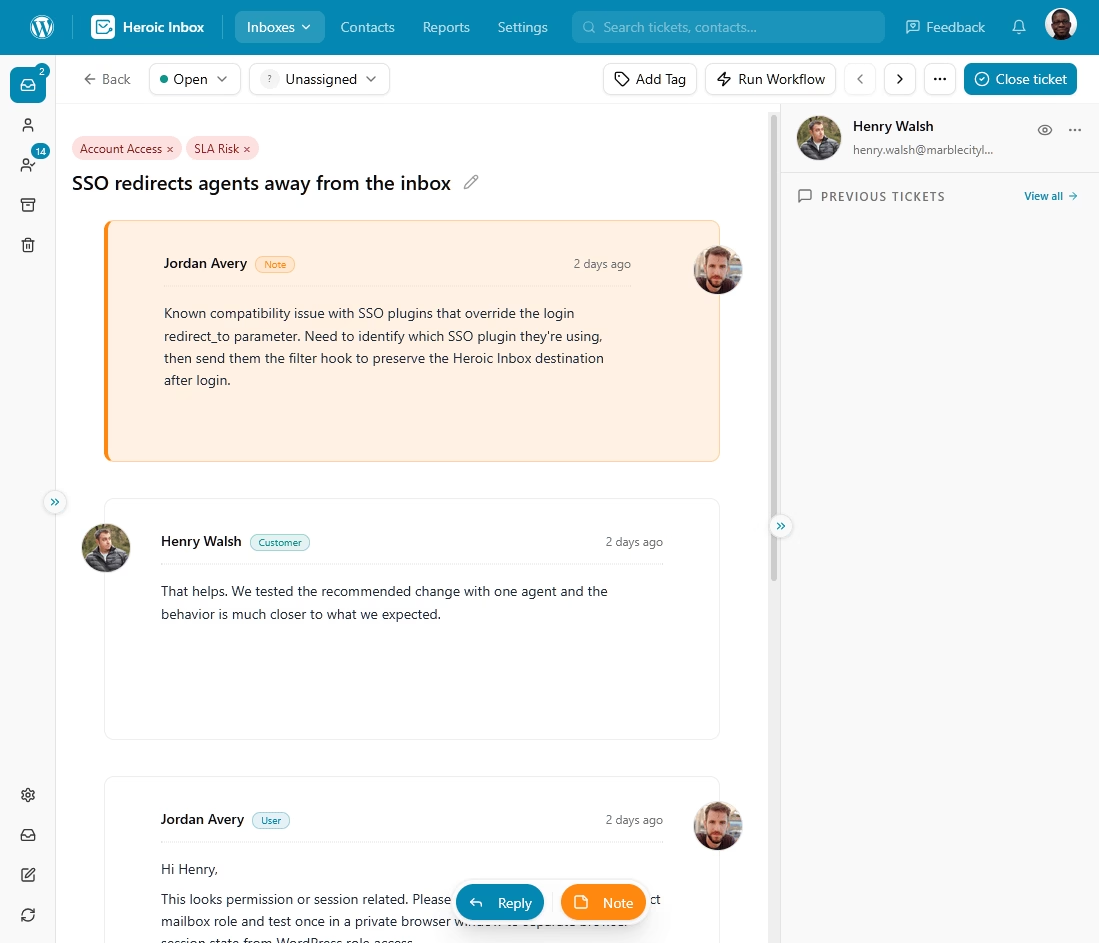
Help your support team resolve customer issues faster with Heroic Inbox, which keeps conversations organized and makes collaboration easier.
Unlimited users and powerful features.
Alternatives to “Sorry for the Inconvenience” for Delays and Long Waits
1. Thank you for your patience while we sort this out
Flipping from apology to appreciation works beautifully when a delay is genuinely out of your hands.
For example, if a shipment is grounded due to weather or if there is a carrier holdup.
Thanking customers can restore satisfaction better than apologizing. Because gratitude lifts the customer’s sense of importance rather than reminding them of the failure.
Use this polite alternative when a customer has waited and the delay wasn’t your fault.
Also tidy the sentence before it: “Because gratitude lifts…” is a fragment. Join it to the previous sentence with a comma.
Example:
Thanks so much for your patience while we track down your order. I've flagged it with our warehouse and will email you an update by the end of the day.2. I appreciate you sticking with me while I get this fixed
It’s warmer than a simple thank-you, and this one fits live chat and one-to-one email threads.
Example:
I appreciate you sticking with me while I fix this. I'm pulling up your account. Give me a minute, and I'll have an answer for you.3. I’m sorry you’ve had to wait longer than you should have
When the delay is squarely your fault, say so.
Example:
I'm sorry you've had to wait longer than you should have for a reply. That one's on us, and I'm putting your request at the top of my list right now.Other Ways to Apologize for Mistakes and Errors
4. We take full responsibility for this
Few things cool down a heated situation faster than taking ownership of it.
Use this alternate phrase when the mistake is unambiguously yours:
- A wrong shipment
- Account mix-up
- Promise you didn’t keep
There’s no hedging in it, which is exactly why it works.
Example:
We made a mistake processing your request, and we take full responsibility for the delay. Here's what we're doing to correct the situation.5. That’s on us, and here’s how we’ll fix it
This one alternate way of saying “Sorry For The Inconvenience” is plain, human, and refreshingly direct.
This pairs accountability with action in a single breath.
Example:
That's on us, we shipped the wrong size. A replacement goes out today and lands tomorrow, and please keep the first one. No return needed.6. Let me make this right
Short, confident, reassuring.
This phrase tells the customer the problem stops with you, which is why it shines on the phone and in chat, where you want to pivot straight to a solution without a paragraph of preamble.
Example:
I can see we charged you twice, and I'm sorry about that. Let me make this right by refunding the extra charge today.7. I realize this meant [specific consequence] for you, and I’m sorry
Naming the real-world consequences demonstrates your understanding of the actual impact on the customer, beyond acknowledging an error occurred.
This is the direct antidote to the vague “inconvenience,” because it gets specific about the harm.
Example:
I realize this delay meant you couldn't send the proposal to your own client on time, and I'm sorry. Let's get you a working file within the hour.8. Thanks for flagging this, you’ve actually helped us
When a customer reports a problem you didn’t know about, expressing gratitude can transform the entire interaction.
Their complaint becomes a favor instead of a fight, which lowers the temperature before you even get to the fix.
Example:
Thanks for flagging this. You've helped us catch a bug that was affecting other customers too, and we're rolling out a fix this week.Apology Phrases for Outages and Service Disruptions
9. We apologize for the disruption to your service
During widespread downtime, a clear and slightly more formal apology reassures everyone that you are addressing the issue. It works well in outage emails and status page updates.
Example:
We apologize for the disruption to your service this morning. Our dashboard was offline from 9 to 10 a.m. due to a server issue, but it's fully restored now. We've also added safeguards to prevent this from happening again.10. Here’s what went wrong and what we’re doing about it
Transparency is the currency of trust during an outage. Using this phrasing signals that you are not hiding behind vague “technical difficulties.” It works equally well in a mass email or a status page note.
Example:
Here's what went wrong and what we're doing about it. A failed update broke logins for roughly 40 minutes. We rolled it back and added a check to prevent this from happening again.11. We know you rely on us, and we’re sorry we let you down
When the outage disrupts a customer’s own business, acknowledge that dependence directly. This carries real weight for B2B clients who run their operations on your product. It also shows them that you understand the stakes.
Example:
We know you rely on our platform to run your store, and we apologize for letting you down during your busiest hour. Your account manager will call you today to offer a credit and discuss a plan to prevent this from happening again.Alternatives for Support and Service Failures
12. I’m sorry this happened
Sometimes the cleanest apology is the most direct one. No “if,” no qualifiers, no corporate cushioning.
Example:
I'm sorry this happened. The way that call was handled isn't the standard we hold ourselves to, and I've already passed your feedback to the team lead.13. I understand how frustrating this must be
Show empathy first, then offer a solution. This is an effective way to start a conversation, especially when someone’s clearly fed up.
Example:
I understand how frustrating this must be after three calls about the same issue. Let me take ownership from here so you don't have to explain it a fourth time.14. You’re right, and I’m sorry we missed the mark
Validating the customer’s position can defuse tension immediately. Reserve this approach for moments when the customer is clearly right and arguing would only make matters worse.
Example:
You're right, and I'm sorry we missed the mark on the install date we promised. I've booked you the earliest available slot and waived this month's fee.Formal Ways to Say Sorry for the Inconvenience in Writing
15. Please accept my sincere apologies for [issue]
For senior clients, formal apology letters, or sensitive situations, this wording carries the right amount of gravity. It sounds serious and professional without being cold, as long as you address the specific issue rather than keeping it generic.
Example:
Please accept my sincere apologies for the error on your latest invoice. It has been corrected, and your account has been credited for the difference.16. We deeply regret the trouble this has caused you
This is a slightly more formal approach that balances genuine regret with accountability.
Well suitable for written notices and B2B communication.
Example:
We deeply regret the trouble this delay has caused you. We've expedited your shipment at no charge and will send tracking details within the hour.17. This shouldn’t have happened, and we’re making sure it won’t again
When you need to rebuild trust, point to prevention. This reassures customers that the problem was an isolated incident and not the start of a pattern, which is often their greatest fear after something goes wrong.
Example:
This shouldn't have happened, and we're making sure it won't happen again. We've added a second review step to our shipping process so every order gets double-checked before it leaves the warehouse.Final Thoughts: Replace Sorry for the Inconvenience with a Real Apology
“Sorry for the inconvenience” survives because it’s quick and safe, and quick-and-safe is exactly what a frustrated customer doesn’t want from you.
They want to feel heard, to see you own the mistake, and to know what happens next.
Every one of the 17 alternatives above does at least one of those jobs better than the stock phrase ever managed, so pick the one that fits the situation and adjust the details.
Further Reading
Apology Email Templates for Every Situation (With Writing Tips)
The 14 Best Subject Lines for Apology Emails
12 Correction Email Subject Lines to Prevent Confusion
Professional Correction Email Examples and Templates (Plus Writing Tips)
How to Respond to Angry Emails: Tips, Strategies, and Examples
Support Ticket Response Templates for Fast, Consistent Customer Service






Leave A Comment?
You must be logged in to post a comment.